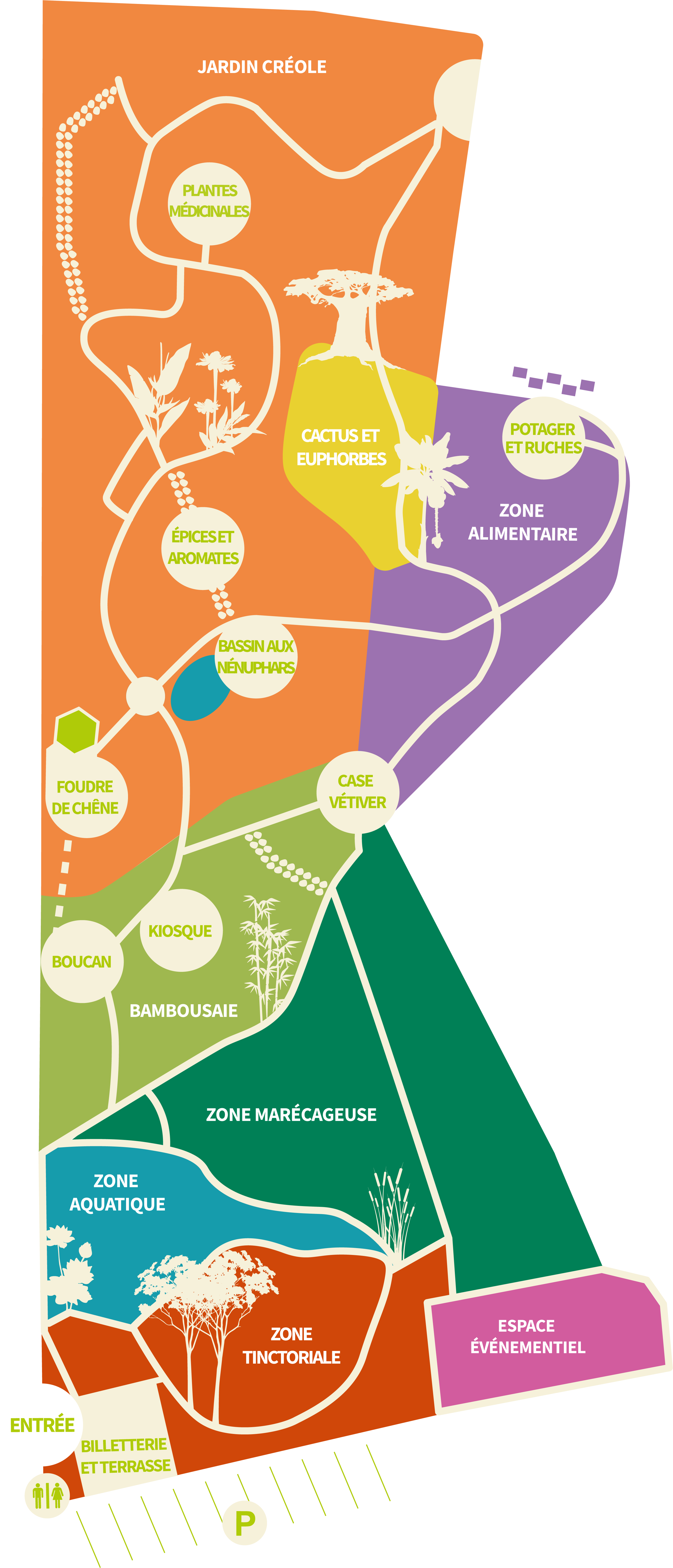
The Jardin d’Eden is a haven of peace for animals.
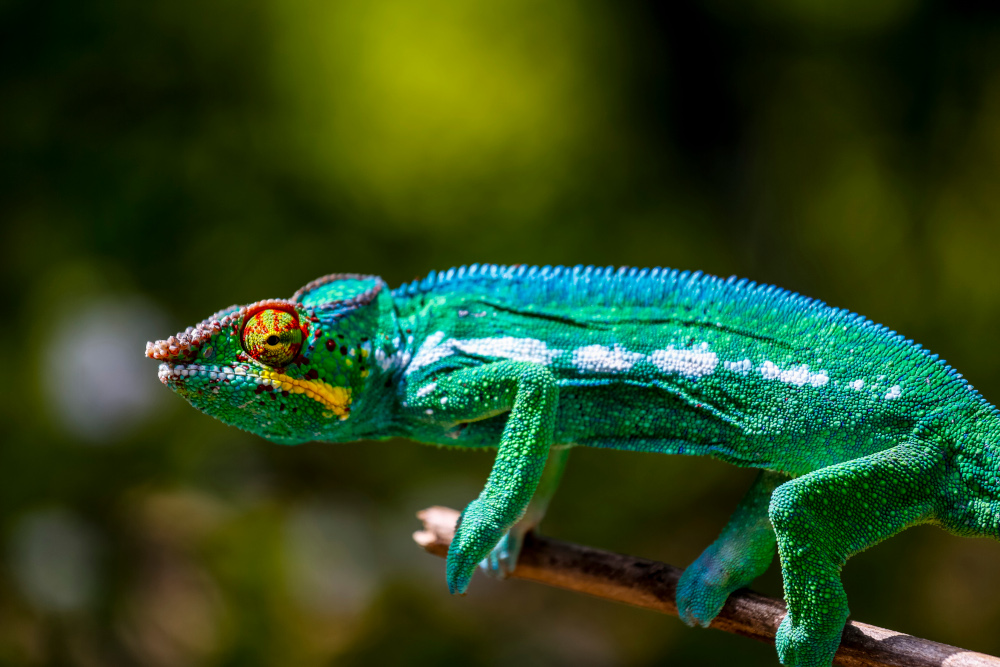
One of its most emblematic residents is the endormi, the local name for the chameleon.
There are around 200 species of chameleons across the world.
It was introduced to the island at the end of the 18th century and has since settled along the coastal fringe up to an altitude of 800 metres (including the Jardin d’Eden).
In Reunion Island, they are called “endormis” (sleepy): if you manage to spot one, you will see that even when frightened, they move as slowly as tortoises.
You cannot mistake them for the lightning-fast lizards such as agamas!
They are most often spotted among the bamboo or in the Creole garden.
Please remain discreet and avoid using flash photography, as it can blind them.
Without eyesight, our insectivorous mascot can no longer hunt, which inevitably leads to death.
Sexual dimorphism is very pronounced in this species.
Males display striking bluish-green colours with red and yellow markings and a pale stripe along the back, while females are a warm ochre-orange.
They have two sets of fused toes, forming a strong grip to grasp branches, which they can also hold with their prehensile tail.
They always move cautiously and are masters of camouflage.
They can slim down or puff up, remain perfectly still, and shift their colours from very pale to very dark.
Their protruding eyes can move independently of one another in all directions.
When their eyes converge, they achieve the binocular precision needed to judge the exact distance to their prey.
They can then shoot out their tongue, as long as their body and coated with sticky mucus, trapping their prey, mainly insects and spiders.
From February to April, they enter their mating season.
The female then lays around twenty small white eggs, who becomes highly aggressive and turns almost black in colour.
She buries her eggs in the ground.
If they are not eaten by red ants, the eggs hatch after 7 to 10 months, producing young measuring about 4 cm long.
More agile than adults and grey-brown in colour, making them almost invisible, they fend for themselves.
The endormi lives between 2 and 4 years and is a good indicator of biodiversity and ecosystem balance; unfortunately, it is too often an unfortunate victim of mosquito-control campaigns and cats.